

The timeline for the arrival of the Messiah.
The prophecy in Daniel 9:24-27 is one of the most profound messianic prophecies in the Bible, outlining a precise timeline for the arrival of the Messiah and the fulfillment of God’s redemptive plan for Israel.

A Study on Daniel 9:24-27
Introduction
This passage presents a 70-week period specifically appointed to prepare God’s people for the coming of the Messiah. As a crucial part of the broader 2300-day prophecy (Daniel 8:14), it offers key insights into Jesus’ ministry, His sacrifice, and the beginning of the investigative judgment.
The 70-Week Prophecy Explained
1. The Context of the Prophecy
Daniel 9 recounts Daniel’s heartfelt prayer of confession on behalf of his people, seeking God’s mercy for Jerusalem and Israel. In response, the angel Gabriel arrives to explain the prophecy of the 70 weeks (490 years), a prophetic timeline revealing when and how God will bring forgiveness and redemption to His people.
2. Daniel 9:24 – The Purpose of the 70 Weeks
“Seventy weeks are determined for your people and for your holy city, to finish the transgression, to make an end of sins, to make reconciliation for iniquity, to bring in everlasting righteousness, to seal up vision and prophecy, and to anoint the Most Holy.”
The six objectives listed in this verse summarize God’s redemptive plan for Israel and humanity. These were to be fulfilled by the Messiah and through Israel’s role in God’s covenant.
It is the Messiah who is going to finish the transgression,
It is the Messiah who is going to make an end of sins,
It is the Messiah who is going to make reconciliation for iniquity,
It is the Messiah who is going to bring in everlasting righteousness,
It is the Messiah who is going to seal up vision and prophecy, and
It is the Messiah who is going to anoint the Most Holy.”
3. Daniel 9:25 – The Beginning of the 70 Weeks
“Know therefore and understand, that from the going forth of the command to restore and build Jerusalem until Messiah the Prince, there shall be seven weeks and sixty-two weeks; the street shall be built again, and the wall, even in troublesome times.”
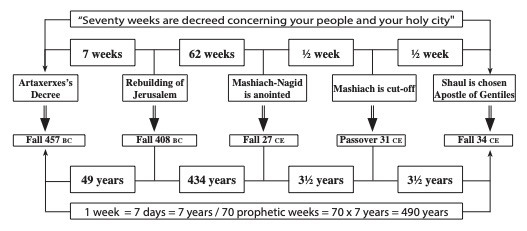
- Start Date: The 70 weeks begin with a decree to restore and rebuild Jerusalem. The decree issued by Artaxerxes in 457 B.C. (Ezra 7) marks this beginning.
- Messiah the Prince: After 69 weeks (483 years), the Messiah would come. Counting from 457 B.C., this leads to A.D. 27, the year of Jesus’ baptism and the beginning of His ministry.
4. Daniel 9:26 – The Messiah’s Death
“And after the sixty-two weeks Messiah shall be cut off, but not for Himself; and the people of the prince who is to come shall destroy the city and the sanctuary. The end of it shall be with a flood, and till the end of the war desolations are determined.”
- “Messiah shall be cut off” refers to the crucifixion of Jesus in A.D. 31, in the middle of the last prophetic week (the 70th week).
- The destruction of Jerusalem in A.D. 70 by the Romans fulfills the prophecy about the city and the sanctuary being destroyed.
5. Daniel 9:27 – The Covenant and the 70th Week
“Then he shall confirm a covenant with many for one week; but in the middle of the week he shall bring an end to sacrifice and offering. And on the wing of abominations shall be one who makes desolate, even until the consummation, which is determined, is poured out on the desolate.”
• “Confirm the covenant” refers to Jesus’ ministry and His reaffirmation of God’s covenant with Israel, which was later extended to the Gentiles.
• “In the middle of the week” (3.5 years into the final 7 years), Jesus was crucified after three and a half years of ministry, bringing fulfillment to the sacrificial system.
• After His death, God’s message continued to be preached to the Jews. In A.D. 34, with the conversion of Rabbi Saul of Tarsus—who accepted Jesus as his Savior and was commissioned to bring the Gospel to the Gentiles—the 70-week prophecy concluded, marking the expansion of the Gospel beyond Israel.
Connection to the 2300-Day Prophecy
• The prophecy of the 2,300 evenings and mornings in Daniel 8 lacks a starting point, which is why Daniel expresses his confusion: “I, Daniel, fainted and was sick for days; afterward I arose and went about the king’s business. I was astonished by the vision, but no one understood it.” (Daniel 8:27).
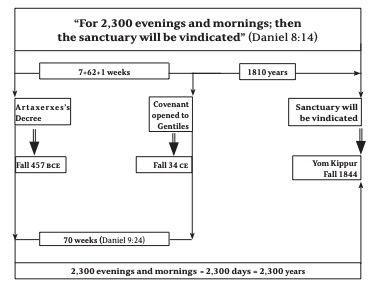
• In response to Daniel’s prayer at the beginning of chapter 9, the angel Gabriel returns to clarify the vision he did not understand—the 70-week prophecy. This prophecy serves as the first segment of the 2,300-day prophecy (Daniel 8:14).
• Since the 70 weeks (490 years) begin in 457 B.C. and conclude in A.D. 34, the remaining 1,810 years extend the prophecy to 1844.
• Yom Kippur of 1844 holds significant theological meaning in Daniel’s prophecy as the beginning of the Investigative Judgment. At this time, Jesus entered the Most Holy Place in the heavenly sanctuary, marking the final phase of His priestly ministry. Just as the High Priest entered the Most Holy Place in the earthly sanctuary on the Day of Atonement, Christ commenced His work of judgment in preparation for His Second Coming.
Conclusion
The prophecy of Daniel 9:24-27 outlines a significant timeline related to the Messiah’s coming, ministry, atoning death, and the destiny of Jerusalem. This prophecy arrives as a direct response to Daniel’s fervent prayer (Daniel 9:3-20), where he sought God’s forgiveness for his own sins, the sins of his people, and the desolation of Jerusalem. The angelic message delivered to Daniel, therefore, addresses the core concerns of his prayer. This prophecy can be understood in the following way:
- The Initial Period: The first seven weeks point to the period involving the restoration and rebuilding of Jerusalem and the temple. (7 weeks or 49 years from 457 to 408 BC).
2. The Messiah’s Arrival: The prophecy also pinpoints the coming of the Messiah, specifically His entry into public ministry. (The 62 weeks, representing 434 years, extend from 408 BC to 27 AD. Remember, the calendar does not include a year zero; it goes straight from 1 BC to 1 AD)
3. Atonement and Fulfillment: Crucially, the prophecy addresses Daniel’s plea for forgiveness. The Messiah’s being “cut off” in the middle of the final week signifies His atoning death, providing forgiveness for Daniel and his people. This final week (7 years extend from 27 to 34 AD) culminates in the spread of the gospel to the world. The Apostle Paul became God’s chosen instrument to take the message of the Messiah to the Gentiles.
The 70-week prophecy also connects to the broader 2300-day prophecy. The 2300-day prophecy is understood to point to 1844, with the calculation derived from the end of the 70 weeks (34 AD) and the remaining portion of the 2300 years (2300 – 490 = 1810 years). This year, 1844, is seen as the commencement of Messiah’s final work of judgment. Ultimately, these prophecies underscore God’s perfect timing, faithfulness, and comprehensive plan for redemption.
Discussion Questions
- How does Daniel’s prophecy strengthen our faith in Jesus as the Messiah?
- What lessons can we learn from the way Israel responded to Jesus’ ministry?
- Why is it significant that Jesus’ death fulfilled the sacrificial system?
- How does the fulfillment of prophecy assure us of the reliability of Scripture?
- What is the connection between Daniel 9 and the doctrine of the Investigative Judgment?
This study invites us to trust in God’s plan and recognize that prophecy reveals His love, justice, and faithfulness throughout history.
Dr. Richard Elofer, D.I.S.
(Fuller Seminary, School of Intercultural Studies)
Pastor, Hebrew Professor, Writer